What is a worldschooling hub? (And why Cacao Coast Classroom is something different)
If you have spent any time in worldschooling circles, you have encountered the term. Worldschooling hub. It appears in directories, Facebook groups, Instagram captions, and family travel blogs. It is used to describe everything from a loose gathering on a beach in Bali to a structured three-week programme in Peru. It is worth slowing down and understanding what it actually means.
The term worldschooling hub has no governing body and no fixed definition. That is not a criticism, it reflects the nature of a movement that grew organically, from families making unconventional decisions and sharing what they found. But it does mean that when you search 'worldschooling hub' and compare results, you are not comparing like with like.
This post is an attempt to be genuinely useful to families in that position. We will explain what worldschooling hubs are, map the range of what exists, offer questions worth asking any programme, and be honest about where Cacao Coast Classroom sits in relation to all of it, which is, in important ways, slightly outside the hub model altogether.
We say that not as a boast, but as a clarification. The word hub is simply not the most accurate description of what we do, and families deserve accurate descriptions before they make a decision of this significance.
What is a worldschooling hub?
At its broadest, a worldschooling hub is a gathering point for families who are educating their children through travel. The hub provides some combination of structured learning, community, and shared experience that individual families travelling alone could not easily create for themselves.
The value proposition is clear: worldschooling families often cite loneliness and the lack of sustained community as their biggest challenges. When children travel continuously, friendships are difficult to maintain. When parents are also the educators, they carry the full weight of both roles. A hub offers relief from both: children find peers, and adults find a context in which to share the labour and the experience of this unconventional life.
Beyond that, the word hub is doing a lot of work for a very diverse set of offerings. Here is an honest map of what the term covers.

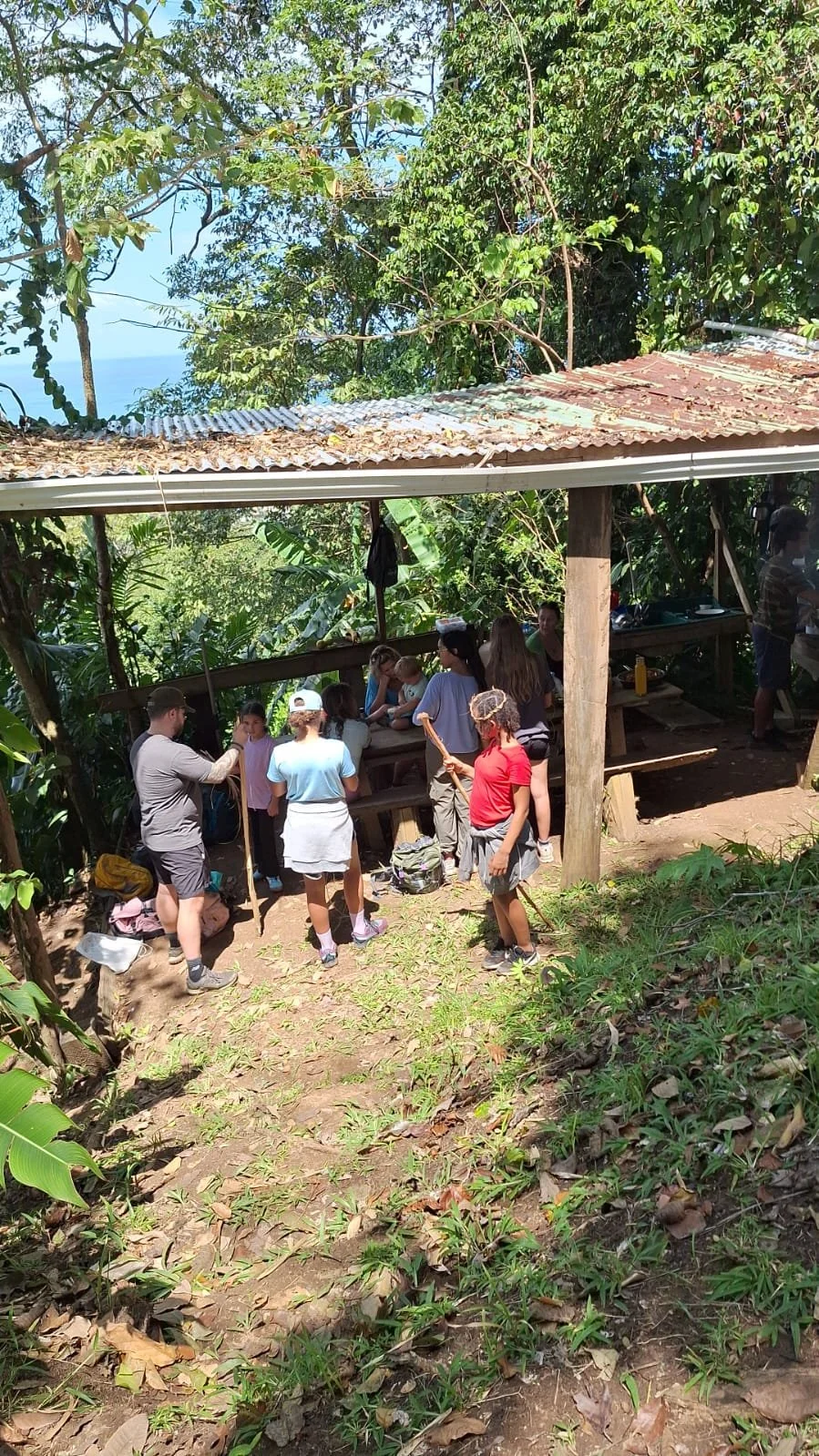
Climbing a Jackfruit tree to harvest ingredients for our communal lunch
The spectrum: what worldschooling hubs actually look like
Think of worldschooling provision as a spectrum, from the most informal to the most structured. Each point on it has genuine value. The question is which type fits your family.
Pop-up hubs and family gatherings
At the informal end, pop-up hubs are temporary meetups sometimes a week, sometimes less organised for worldschooling families in a specific location. The emphasis is almost entirely on community rather than curriculum. Families might share beach days, a visit to a local market, an evening meal. Activities are often optional, loosely scheduled, and parent-led.
These gatherings are valuable precisely because they are low-pressure. Families can attend for three days or the whole week. Children mix freely. Parents talk to other parents who understand what this life actually looks like. There is no application process, minimal cost, and no expectation beyond showing up.
Organisations like Worldschool Pop-Up Hub have built entire models around this format, running events across dozens of countries each year. For families new to worldschooling, or for those who want connection without commitment, this end of the spectrum is often the right starting point.
Programme hubs
Further along the spectrum are what we might call programme hubs: structured educational experiences that run for two to six weeks and are delivered by hired educators in a specific location. Families arrive at the destination, the hub runs sessions each morning or day, and the families are otherwise free to explore the location independently.
These hubs are where the term gets most commonly applied. Deliberate Detour in Oaxaca and Cusco is a well-regarded example. Field School in Hvar, Croatia is another. What these share is an intentionally curated programme, local workshops, cultural visits, expert-led sessions delivered by a team that has assembled those resources for the purpose of the programme.
The quality of programme hubs varies significantly. The best ones have genuine local relationships, educators who are not simply hired for the season, and a coherent educational philosophy. The less strong ones can feel like packaged cultural tourism diverse in activity but thin in depth. The questions in the next section are designed to help you tell the difference.
Long-term and residential communities
At the structured end of the spectrum are longer-term worldschooling communities and schools: six-week to multi-month programmes, often with more formal educational frameworks. The Hive in the Dominican Republic, travelling community programmes like Storylines, and various permanent alternative schools that welcome visiting worldschoolers fall into this category.
These require significantly more commitment, logistically, financially, and in terms of time away from a family's home base. For families who are worldschooling full-time or on a gap year, this end of the spectrum may be exactly right. For families taking a summer, it is often more than they need.
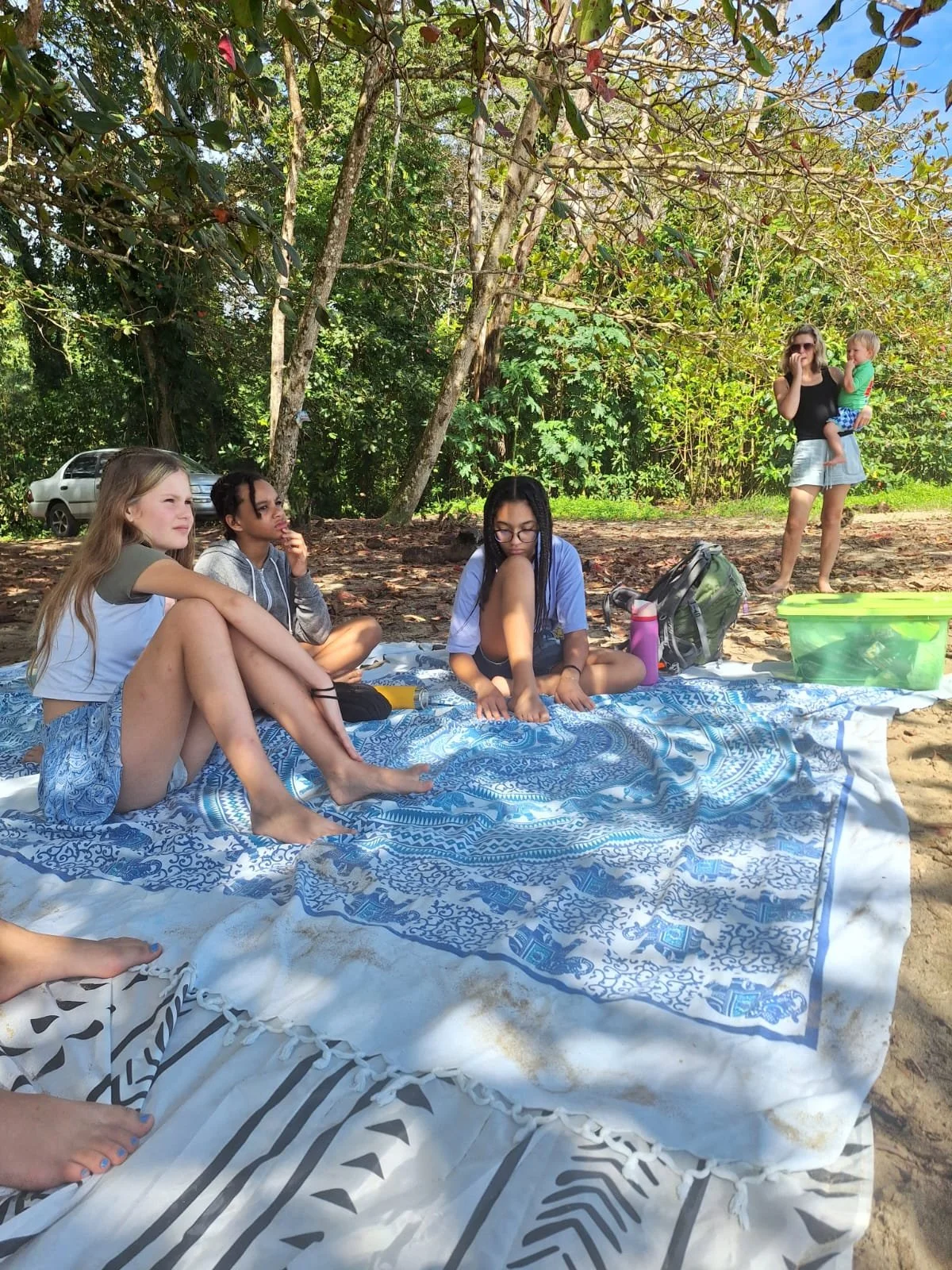
Water safety session with Caribbean Guard
Why the word hub does not quite fit Cacao Coast Classroom
We appear on worldschooling hub directories. We are listed on Worldschooly, referenced by Passport Explorers, and families find us by searching for worldschooling hubs in Costa Rica. We are not going to pretend the word is irrelevant.
But it is not the most accurate description of what we offer, and we think the distinction is worth making clearly.
A hub, in the typical sense, is assembled. Educators are found, relationships are built for the programme, a location is chosen because it offers the right combination of accessibility and interest. The quality of the hub depends on the quality of that assembly. Many hubs do this assembly very well.
What Cacao Coast Classroom is, at its root, is a community that has existed for decades, now formally open to families. The educators who work with children in Seeds & Stories and Roots & Rhythms are not seasonal hires. They are neighbours, community members, specialists whose work and lives are embedded in this place.
Our connections to Indigenous and Afro-Caribbean communities, local educators, and the rhythms of this coastline were not curated for visitors. They are simply our life here.
This is the distinction that matters most for families making an informed choice. A hub can be set up anywhere with the right research and resources. A place-based immersive experience rooted in genuine community cannot. It takes time usually decades of it.
We identify as a place-based immersive learning experience. Not a hub, not a pop-up, not a programme alone. The language matters because the substance behind it matters. Families who come to the Caribbean coast of Costa Rica and spend three weeks in Seeds & Stories or Roots & Rhythms are not attending something that was built for them. They are joining something that was already here.
Questions worth asking any programme before you book
Whether you are considering a pop-up hub, a programme hub, or a place-based experience like Cacao Coast Classroom, these are the questions that distinguish genuine quality from well-marketed surface.
How long have the founders been in this location?
A programme that arrived eighteen months ago and built relationships for the season is a different proposition from one embedded in a community for years. Neither is automatically better, but you should know which you are choosing.
Who are the educators, and what is their relationship to the place?
Are they local community members whose work exists independently of the programme, or are they hired for the programme? Both can be excellent. Local educators with independent lives and relationships tend to offer something qualitatively different from expert facilitators brought in for the season.
How many children are in the programme?
Group size shapes everything: the pace of sessions, the depth of individual attention, the quality of peer relationships. Programmes capped at ten to fifteen participants operate very differently from those that run with thirty. Ask for the cap, not just the typical size.
What does a typical day actually look like?
Any programme worth your attention should be able to answer this in specific, unhurried detail. Not a marketing summary actual times, actual session types, actual names of the places and people involved. Vague answers to this question are a signal.
Do sessions repeat across cohorts, or is each one unique?
For families considering two consecutive programmes in the same destination, this matters. At Cacao Coast Classroom, all educator sessions are unique between Seeds & Stories and Roots & Rhythms families doing both programmes receive a completely fresh experience. Not every programme can say the same.
What is the philosophy behind what children do each day?
A programme should be able to articulate this without resorting to jargon. What do the founders believe about how children learn? What guides the choice of sessions and educators? The answer tells you a great deal about whether the programme was designed with educational intentionality or assembled around what is logistically available.
What happens when something goes wrong?
Weather, illness, a session that falls through. How a programme handles disruption reveals its maturity and its genuine relationship to the location. Programmes rooted in a real community adapt fluidly. Programmes that assembled from outside often struggle.
The honest answer to the question
What is a worldschooling hub? It is a gathering point that offers travelling families something they cannot easily build alone: community, structured experience, and a guided encounter with a place.
That is a good thing to offer. The worldschooling landscape is richer for the diversity of hubs, pop-ups, and programmes that have emerged in the last decade, and families have more genuinely good options in 2026 than they have ever had.
Where it gets more interesting is when you ask not just what a hub is, but what depth of encounter it makes possible. A well-run programme hub in a beautiful location can deliver two excellent weeks. A place-based experience rooted in decades of community relationship can deliver something that children carry differently not a collection of activities, but a changed understanding of what the world contains.
We are biased, obviously. But we are also honest: Cacao Coast Classroom is not the right choice for every family. Some families want the flexibility of a pop-up, the spontaneity of an informal gathering, the freedom to show up and drift. We are more structured than that, and more specific. We run on the Caribbean coast of Costa Rica, for groups of no more than twelve participants, rooted in a community we have lived within for over twenty years.
If that specificity is what you are looking for, we would be glad to tell you more.
The programme pages for Seeds & Stories and Roots & Rhythms describe what each programme actually involves, day by day. Or reach out to Claire and Sam directly questions about whether Cacao Coast Classroom is the right fit are the ones we most enjoy answering.
